
Skip to content
Endoscopic Retrograde Cholangiopancreatography

ERCP

Endoscopic Retrograde Cholangiopancreatography

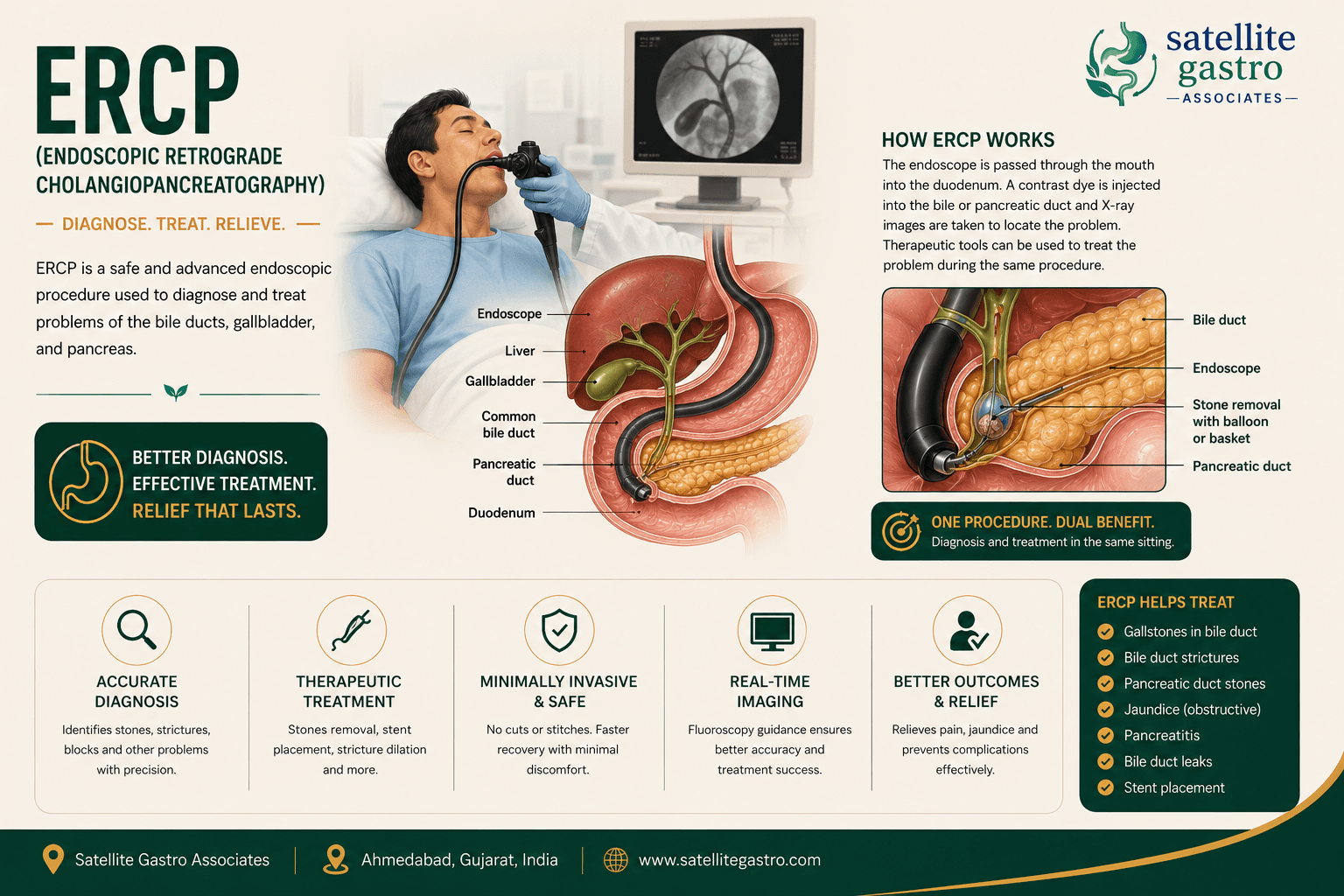
A specialised endoscopic procedure to access and treat conditions of the bile duct and pancreatic duct. Used for stones, strictures, and to place stents when needed.

What is it?

ERCP combines endoscopy with X-ray imaging to access the bile duct and pancreatic duct through the duodenum.

It is primarily a therapeutic procedure: stones are removed, narrowed segments stretched, and stents placed to relieve obstruction.
Who needs it?

  • Bile duct stones causing jaundice, pain, or infection.
  • Bile duct narrowing from prior surgery, inflammation, or tumour.
  • Pancreatic duct stones or strictures.
  • Bile leak after gallbladder surgery.

How it works

Performed under sedation or general anaesthesia.

The duodenoscope is passed to the area where the bile and pancreatic ducts open into the duodenum.

A small cut may be made at the opening (sphincterotomy) to allow access. Stones are extracted with a basket or balloon. A stent may be placed if needed.

Most ERCPs take 30 to 60 minutes.

Preparation

  • No food for 6 hours before. You may be admitted briefly.
  • Stop blood thinners as advised, usually 5 days in advance.

Recovery

  • Observation for several hours after the procedure to watch for the (uncommon) risk of pancreatitis.
  • Most patients go home the same day or the next morning.

Risks

ERCP carries a higher risk profile than diagnostic endoscopy. Pancreatitis (inflammation of the pancreas) occurs in about 5% of cases and is usually mild.

Bleeding from the sphincterotomy site, infection, and perforation are uncommon.

These risks are explained in detail before the procedure.

Common questions

Things patients ask us.

Why ERCP instead of surgery?

For most bile duct stones, ERCP is faster, has fewer complications, and avoids a surgical incision. Some cases still need surgery, and we will tell you which group you fall into.

Will I need a stent permanently?

Most stents are temporary, removed or exchanged after 4 to 12 weeks depending on the condition.